
Last updated:
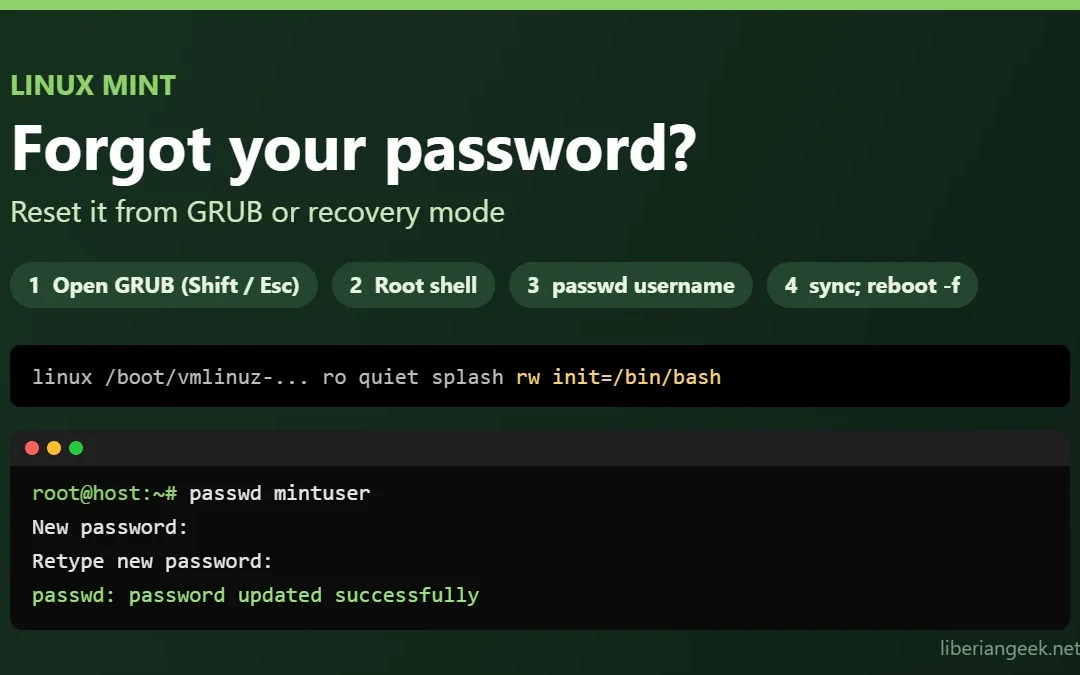
Quick answer: restart the computer, open the GRUB menu (hold Shift, or press Esc on UEFI systems), and get a root shell, either by adding init=/bin/bash to the boot entry or by choosing root in the recovery menu. Then run passwd your-username (for example passwd mintuser), type the new password twice, and reboot. If passwd says Authentication token manipulation error, run mount -o remount,rw / first. Run ls /home if you are not sure of the username.
The screenshots were taken on Linux Mint 21.3 Cinnamon. Linux Mint 22.x is also Ubuntu-based and boots through GRUB the same way, so the steps match; only the version numbers in the menu differ. Choose the method that fits your situation:
| Situation | Best method | You need |
|---|---|---|
| You forgot the password of the only (admin) account | Method 1: GRUB init=/bin/bash, or Method 2: recovery mode | Physical access to the computer |
| Recovery mode asks “Give root password for maintenance” | Method 1: GRUB init=/bin/bash | Physical access |
| Another account with sudo rights still works | Method 3: sudo passwd username | That account’s password |
Before you start: this is for a computer you own or administer. Resetting the login password does not unlock an encrypted home folder; files there stay protected by the encryption passphrase. With full-disk encryption you still type the disk passphrase at boot as usual, and these steps work after that.
Method 1: Reset the password from the GRUB menu (init=/bin/bash)
This boots straight into a root shell without asking for any password. Restart the PC and hold Shift as it starts (or tap Esc on most UEFI machines) until the GRUB menu appears. If it never appears, see how to open the Linux Mint GRUB and recovery menu or the GRUB fix at the end of this guide. Select Advanced options for Linux Mint … Cinnamon:

Highlight the normal kernel entry (not the recovery mode one) and press e to edit its boot commands:

Find the line that starts with linux and ends with quiet splash:

Move to the end of that line and add rw init=/bin/bash. rw mounts the root filesystem writable, and init=/bin/bash starts a root Bash shell instead of the normal startup. The change applies to this one boot only; nothing is saved to disk.

Press Ctrl+X or F10 to boot. You land at a root@...:/# prompt. List the accounts, then reset the password for your username:
ls /home
passwd mintuser
Replace mintuser with your username. Do not run passwd on its own here: you are root, so plain passwd changes the root password, not yours. That is what happened in the next screenshot, which is why the username matters.

Setting a root password is optional. Linux Mint leaves root without a usable password by default and uses sudo instead, so you can skip this unless you really want a root password:
passwd root
This shell runs without the normal init system, so the usual reboot command may not work. Write the changes to disk and force a restart:
sync
reboot -f
sync matters here: according to the systemd documentation, reboot -f does not contact the init system, and filesystems are usually not unmounted cleanly before the restart. After the reboot, log in with the new password.
Method 2: Reset the password in recovery mode
Recovery mode gives you a root shell through a menu. Open the GRUB menu as above and choose Advanced options for Linux Mint … Cinnamon:

Select the entry that ends in (recovery mode) and press Enter:
Stuck at this step? Ask us, it is free and include the exact error.

In the Recovery Menu, choose root – Drop to root shell prompt. Notice the header says filesystem state: read-only:

Because the disk is read-only, make it writable first, then reset the password:
mount -o remount,rw /
passwd mintuser
If you skip the remount, passwd fails. This is the exact error, captured on Ubuntu 24.04 with /etc mounted read-only:
New password: Retype new password: passwd: Authentication token manipulation error
passwd: password unchanged
If recovery mode asks Give root password for maintenance and you do not know the root password, pressing Ctrl+D just continues the normal boot. Use Method 1 instead. When the password is changed, type exit to go back to the menu and choose resume to boot normally:

Method 3: Reset another user’s password with sudo
If you can still log in with an account that has administrator (sudo) rights, you do not need GRUB at all. Open a terminal in that account and run:
sudo passwd mintuserEnter your own password for sudo, then the new password for mintuser twice. Older versions of this guide said Linux Mint gives root the same password as the first user. That is not how a current install works: the root account is locked, so su root fails until a root password is set. You can check this with sudo passwd -S root; an L in the second field means the password is locked. Output captured on Ubuntu 24.04, which Linux Mint 22 is based on:
root L 2026-10-24 0 99999 7 -1
Fix: the GRUB menu does not appear
On many single-OS installs GRUB is hidden, and Shift or Esc can be hard to time. While you can still log in (or from the root shell in Method 1), make the menu visible. Back up the file first so you can undo the change:
sudo cp /etc/default/grub /etc/default/grub.bak
sudo nano /etc/default/grub
Set GRUB_TIMEOUT_STYLE=menu (instead of hidden) and GRUB_TIMEOUT=5 so the menu waits five seconds. Save with Ctrl+S and exit with Ctrl+X:

Apply the change:
sudo update-grub
To undo it, restore the backup with sudo cp /etc/default/grub.bak /etc/default/grub and run sudo update-grub again.
Troubleshooting
| Problem | Cause | Fix |
|---|---|---|
passwd: Authentication token manipulation error | The root filesystem is mounted read-only (recovery mode) | mount -o remount,rw /, then run passwd username again |
| “Give root password for maintenance” | Root has a password you do not know | Use Method 1 (init=/bin/bash) |
su: Authentication failure | Root is locked by default on Linux Mint | Use sudo from an admin account |
| Your password still does not work after reboot | You ran passwd without a username and changed root instead | Repeat the steps with passwd your-username |
reboot fails in the init=/bin/bash shell | No init system is running in that shell | sync, then reboot -f |
| After login you are asked to unlock the “login keyring” | The keyring is still encrypted with the old password | Enter the old password if you remember it; otherwise rename ~/.local/share/keyrings/login.keyring (saved passwords in it are lost) and log in again |
| Files in an encrypted home folder are not accessible | Home encryption uses its own passphrase | Use the encryption passphrase saved when encryption was set up |
Security note: as these steps show, anyone with physical access to an unencrypted Linux Mint PC can reset its passwords from GRUB. If that matters for your machine, use full-disk encryption, which you can select when installing Linux Mint.